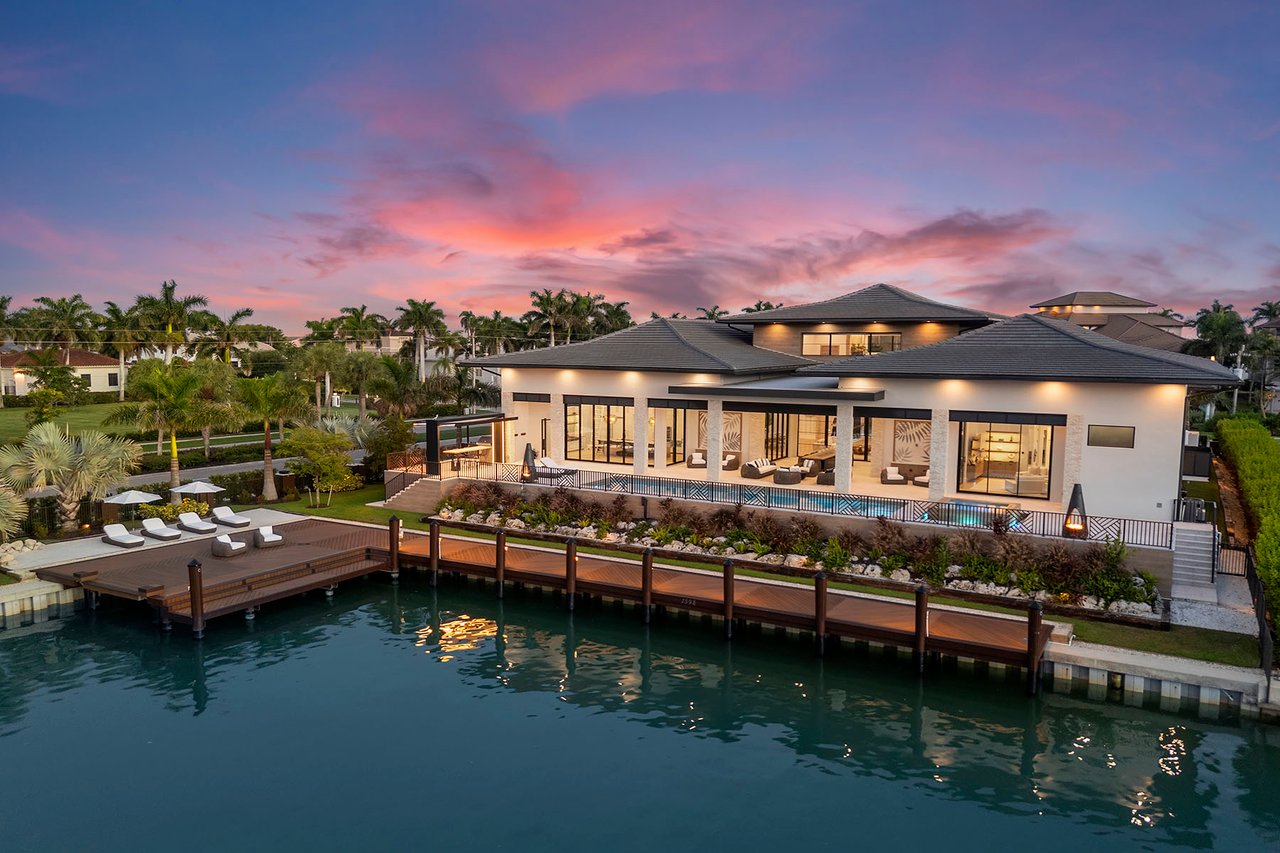
Luxury Home Pricing in Marco Island and Naples: Why the Right Price Requires More Than Comparable Sales
One of the most important conversations I have with luxury homeowners considering selling in Marco Island or Naples is also one of the most complicated:
What is my home really worth?
At the luxury level, the answer is rarely as simple as finding three recent sales, calculating an average price per square foot and applying it to the property.
In fact, that approach can lead to some of the biggest pricing mistakes I see.
Luxury real estate in Southwest Florida is extraordinarily nuanced. Two homes with similar square footage can differ in value by hundreds of thousands, or even millions, of dollars because of characteristics that don't show up in a basic comparable-sales report.
Waterfront.
View.
Exposure.
Lot.
Boating access.
Elevation.
Architecture.
Condition.
Privacy.
New construction.
Outdoor living.
And perhaps most importantly, how difficult the property would be to replicate.
That's why pricing a luxury home in Marco Island or Naples requires more than running comps.
It requires understanding what today's luxury buyer is actually willing to pay a premium for.
Luxury Buyers Are Buying, But They're Selective
The Southwest Florida luxury buyer hasn't disappeared.
But the market has changed from the period when rapidly rising demand could sometimes compensate for aggressive pricing.
Recent 2026 market data shows buyers have choices and are negotiating.
In Marco Island's single-family luxury market, an April 2026 luxury report showed a median sale price of $2.55 million, with properties selling for a median 94.72% of list price. The same report showed 140 luxury homes in inventory and 30 sales during the month.
In the broader Collier County luxury single-family market, July data showed a 91.3% list-to-sale ratio and an average of 163 days on market among active listings.
The takeaway isn't that luxury real estate isn't selling.
It is that buyers are distinguishing between properties.
They will pay for exceptional real estate.
They are less willing to pay an exceptional price for an ordinary property.
Price Per Square Foot Has Limits in Luxury Real Estate
Price per square foot is useful.
I look at it.
Buyers look at it.
Appraisers look at it.
But it should be a reference point, not the entire pricing strategy.
Consider two 4,000-square-foot homes on Marco Island.
One might offer quick, direct access to open water, southern exposure, a wide canal, long water views, a newer seawall, substantial dockage, high elevation and recent construction.
Another 4,000-square-foot home may have indirect boating access, bridge restrictions, an older seawall, a narrower canal and an interior that requires substantial renovation.
The square footage may be almost identical.
The buyer experience isn't.
The same principle applies in Naples.
Two condominiums with similar interior square footage may have dramatically different values because of floor height, Gulf views, building quality, renovation level, amenities or location.
Two single-family homes may differ because one is in Port Royal and another is several neighborhoods away.
Luxury buyers don't purchase square footage in isolation. They purchase the complete property.
On Marco Island, Waterfront Can Change Everything
Waterfront is one of the clearest examples of why luxury pricing requires hyper-local knowledge.
Marco Island's January 2026 market data showed a substantial difference between waterfront categories. Direct-waterfront single-family homes had an average closed price of approximately $3.15 million over the preceding 12 months, compared with approximately $1.89 million for indirect-waterfront homes and $1.10 million for inland homes.
But even "direct waterfront" is too broad a category to determine the value of an individual property.
When I'm evaluating a Marco Island waterfront home, I want to understand:
How quickly can you reach open water?
What size boat can the property accommodate?
Are there bridges?
How wide is the canal?
How deep is the water?
How much waterfront footage is there?
What is the condition of the seawall?
What type of dock and lifts are installed?
What direction does the rear of the home face?
Is it a canal view, converging-water view, bay view or open-water view?
Is the lot standard, oversized, a corner lot or a tip lot?
Those characteristics aren't footnotes.
At the luxury level, they can be fundamental components of value.
Naples Luxury Pricing Requires the Same Level of Precision
Naples is even more difficult to summarize with one market statistic because "Naples luxury real estate" encompasses so many different markets.
Port Royal.
Aqualane Shores.
Old Naples.
Park Shore.
Pelican Bay.
Grey Oaks.
Beachfront high-rises.
Golf communities.
New construction.
Gulf-access properties.
Each has its own buyer pool, inventory, pricing dynamics and definition of scarcity.
Recent Naples waterfront sales illustrate just how wide the luxury spectrum can be. From August 1 through September 18, 2026, 59 waterfront properties closed with approximately $347.5 million in total volume. Among waterfront sales of $1 million or more, single-family homes had a median sale price of $6.55 million, while condominiums had a median of approximately $1.855 million.
Those are both "Naples waterfront luxury."
They are clearly not the same market.
That's why a meaningful pricing strategy begins by identifying the actual competitive set for a property.
Condition Is Becoming a Bigger Part of the Pricing Conversation
Today's luxury buyer is also paying close attention to condition.
There is an important difference between a property that is technically move-in ready and one that feels immediately desirable.
Buyers notice:
The roof.
Impact windows and doors.
Flooring.
Kitchen and bathrooms.
Lighting.
Landscaping.
Furniture and staging.
Outdoor living.
Pool condition.
Technology.
Storm resilience.
And whether the design feels current.
At the luxury level, buyers aren't simply asking:
"Could I renovate this?"
They're calculating the time, cost and inconvenience required to make the property what they want.
When two properties compete at similar prices and one provides a substantially more turnkey experience, the difference can become meaningful.
New Construction Creates Its Own Pricing Dynamic
New construction is another important component of the Marco Island and Naples luxury markets.
Buyers may be willing to pay a substantial premium for newer construction when it delivers modern architecture, current building standards, elevated construction, impact protection, newer mechanical systems and the design features today's luxury buyer wants.
But "new" alone doesn't determine value.
Location still matters.
Lot quality still matters.
View still matters.
Waterfront still matters.
Floor plan still matters.
And architectural quality still matters.
A new home built on an inferior lot doesn't automatically become more valuable than an exceptional existing home in a superior location.
Again:
You can change a house. You can't change the location.
The Most Expensive Listing Isn't Necessarily Your Best Comparable
This is where pricing conversations can become difficult.
A seller understandably looks at the highest-priced home in the neighborhood and thinks:
"My house is nicer than that one."
Maybe it is.
But there is an important distinction between a property's asking price and evidence of market value.
An active listing tells us what a seller hopes to receive.
A pending sale tells us that a buyer and seller found common ground, although we don't yet know the final number.
A closed sale tells us what a buyer was actually willing to pay.
All three matter, but they tell us different things.
I also want to know what didn't sell.
Expired listings, withdrawn properties and homes that accumulated substantial days on market can provide valuable information about where buyers rejected the pricing.
Sometimes the most useful comparable isn't the property that sold.
It's the one buyers repeatedly passed over.
The First Few Weeks Matter
I believe the first 21 days of a luxury listing are particularly important.
That's when the property has maximum freshness.
Agents notice it.
Active buyers receive alerts.
Marketing launches.
Social content begins circulating.
Photography and video are new.
And the property hasn't accumulated a history of sitting on the market.
That initial period gives us some of the clearest feedback we're going to receive.
If the property generates strong showing activity and meaningful conversations, the market is telling us something.
If buyers consistently view the home but don't make offers, that's information too.
And if there is little showing activity at all, we need to understand why.
In many cases, the market isn't saying:
"We don't like the house."
It's saying:
"We don't see the value at this price."
Overpricing Can Cost More Than a Price Reduction
One of the biggest misconceptions in luxury real estate is that there is little downside to starting high.
"We can always come down."
Technically, that's true.
Strategically, it can be expensive.
A property launches at $5 million.
Buyers compare it with other $5 million properties and decide those alternatives offer better value.
The home sits.
The price drops.
Then it drops again.
Eventually, the home reaches the price range where it might have received significant attention initially.
But now buyers see the days on market and pricing history.
Instead of asking:
"How do I get this house?"
They begin asking:
"What's wrong with it?"
That is a very different negotiating position.
Pricing High Doesn't Necessarily Leave More Room to Negotiate
Another common strategy is intentionally pricing above market value because a seller expects buyers to negotiate.
Some negotiating room can absolutely make sense.
But there is a difference between building reasonable negotiating room into the price and positioning the property outside the buyer's perception of value.
Luxury buyers often establish search parameters.
A buyer comfortable purchasing around $4 million may search to $4.5 million.
They may never see the home priced at $5.25 million.
You can't negotiate with a buyer who never considers the property.
The Goal Isn't to Be the Cheapest Property
Intelligent pricing doesn't mean discounting a luxury home.
Quite the opposite.
My job is to identify every characteristic that supports a premium and make sure the market understands why it matters.
If the home has exceptional boating access, we explain it.
If the elevation is advantageous, we document it.
If the view is difficult to reproduce, we show it.
If the architecture is exceptional, we tell that story.
If significant improvements have been made, we organize the documentation.
If the outdoor living environment is extraordinary, it becomes central to the marketing.
The goal isn't simply to put a price on the house.
It's to build the case for the price.
Luxury Pricing Is Part Data, Part Positioning
The best luxury pricing strategy sits at the intersection of two things.
Data tells us where the market is.
Positioning tells buyers why this property deserves its place within that market.
I use comparable sales, active competition, pending transactions, price-per-square-foot trends, days on market, absorption, inventory and historical listing activity.
But then I layer in the characteristics that spreadsheets don't fully capture:
Scarcity.
View.
Architecture.
Waterfront.
Privacy.
Lifestyle.
Condition.
Emotional appeal.
And replacement difficulty.
That's where luxury pricing becomes more nuanced.
Marco Island and Naples Are Selective Markets
The luxury market in Southwest Florida continues to produce substantial transactions, but today's buyers have information, options and negotiating power in many segments.
That doesn't mean sellers should be pessimistic.
It means sellers should be strategic.
Exceptional properties can still command exceptional prices.
But the market needs to understand why the property is exceptional.
That's the difference between simply putting a luxury home on the market and strategically positioning it.
The market isn't necessarily slow.
It's selective.
And in a selective market, pricing, preparation and presentation have to work together.
Thinking About Selling a Luxury Home in Marco Island or Naples?
If you're considering selling a luxury or waterfront property in Marco Island or Southeast Naples, the first step shouldn't be deciding what number you'd like to see on the listing agreement.
It should be understanding where your property sits in the current competitive landscape.
What has sold?
What hasn't?
What is competing with you today?
What characteristics does your property have that buyers will pay more for?
And what needs to happen before the home ever reaches the market?
That's where intelligent pricing begins.
To request a confidential pricing and positioning analysis for your property, visit DevinSweazyGroup.com.
About Devin Sweazy
Devin Sweazy is a Marco Island Realtor and luxury real estate advisor with Premier Sotheby’s International Realty, specializing in luxury and waterfront homes throughout Marco Island and Southeast Naples.
A Marco Island resident since 2014, Devin combines hyper-local market knowledge with intelligent pricing, sophisticated property marketing, cinematic storytelling and skilled negotiation. With more than $100 million in closed career sales volume, she has been recognized among the top 1.5% of real estate professionals nationwide by RealTrends Verified, is a multi-year member of Premier Sotheby’s International Realty’s Club 1744, recognizing its top advisors, and has been named among the Top 250 agents by Naples Real Producers.
Devin also represented the buyers in Marco Island’s highest-priced residential sale of 2024 at $11.375 million.
To explore Marco Island luxury real estate or discuss buying or selling a waterfront property, visit DevinSweazyGroup.com.